Tradition Lives in Many Voices
Sacred Music and the Beauty of Inculturation
By Christian Paul Leaños
Association of Intercultural Pastoral Musicians
A few weeks ago, I shared a thought about sacred music that has stayed with me:
I like to think of sacred music as a recipe. The Church gives us the essential ingredients—like Gregorian chant and the pipe organ—but every culture uses the herbs and spices that grow in its own soil. The recipe doesn’t change, but its expression does so it can nourish its own people. That is what legitimate inculturation is all about!
Then, just a few weeks later, Pope Leo XIV spoke about sacred music during his General Audience on August 19. I smiled when I read his words. Not because I thought, “See? I was right!” But because I thought: this is a conversation the Church needs to be having.
Pope Leo spoke about the importance of preserving the Church’s musical heritage while also respecting the musical traditions and cultures of different peoples. Ultimately, he brought everything back to something beautifully simple:
“In the liturgy, to sing and to play music means to pray.”
That line has stayed with me. Those of us who work in Catholic music know how quickly conversations about sacred music can become debates. Organ or guitar? Chant or contemporary music? Latin or the vernacular? Traditional or multicultural? Maybe we’ve been asking the wrong question.
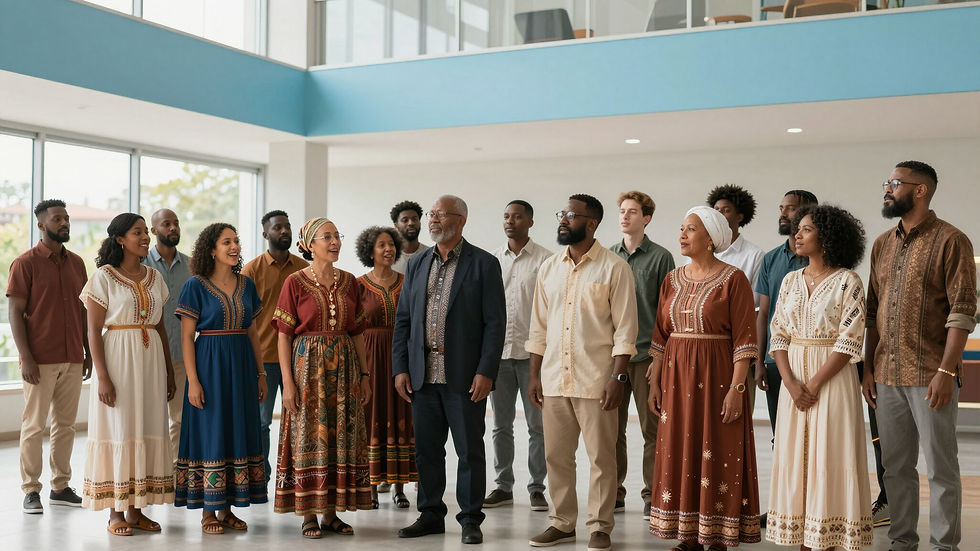
Start With the People in the Pews
We can spend so much time defending one musical style over another that we forget something rather important: the people sitting in the pews.
Look around many Catholic parishes today and you may find people whose families come from Mexico, El Salvador, Nigeria, Cameroon, the Philippines, Vietnam, Haiti, Poland, India, Bolivia, the United States, and countless other places. Some grew up with chant. Others grew up with guitars, drums, devotional songs, Gospel music, multipart singing, or melodies passed from one generation to another. Some learned the faith in English. Others first learned to pray in Spanish, Tagalog, Vietnamese, French, Swahili, or another language.
And somehow, on Sunday morning, all of these people gather around the same altar. That is beautiful. It can also be complicated. Because our task as pastoral musicians isn’t simply to find music everybody likes. Our task is to help the Church pray. And that changes the conversation.
Tradition Doesn’t Mean We All Have to Sound the Same
The Church’s musical heritage matters deeply. Gregorian chant matters. The organ matters. Sacred polyphony matters. Hymnody matters. The music handed down to us over centuries is not something we need to apologize for or abandon in order to welcome different cultures.
But honoring tradition does not require uniformity. The Catholic Church does not belong to one country, one language, or one musical culture. Walk into Catholic churches in different parts of the world and you will hear that immediately. A Filipino community may sing differently from a Mexican community. A Nigerian Catholic community may express joy differently from a French one. African American Catholics carry a musical tradition shaped by faith, suffering, perseverance, hope, and joy. Vietnamese Catholics bring another musical language. Latin American communities themselves contain an enormous variety of traditions—we certainly don’t all sound the same either.
That diversity does not have to threaten Catholic identity. It can reveal it. The challenge is learning how the musical expressions of a people can genuinely serve the liturgy. And I think serve is the key word.
Inculturation Is More Than Adding a Drum
Celebrating culture does not mean that everything belonging to a culture automatically belongs at Mass. Sometimes a song is beautiful but isn’t appropriate for the liturgy. Sometimes a piece carries tremendous cultural importance but doesn’t fit the particular moment we are celebrating. Sometimes we choose something because we think it represents a community, only to discover that the people from that community barely recognize it.
And sometimes, with very good intentions, we can reduce intercultural ministry to a checklist. Let’s add a Spanish song. Let’s use an African drum. Let’s sing something Filipino. Done. Multicultural Mass.
Except...not really. Authentic intercultural ministry asks more of us. Before asking, “How can I include this culture?” perhaps we should first ask: “What can I learn from this community?”
Talk to people. Listen to them. Ask what they sing. Ask what their parents and grandparents sang. Learn about their celebrations and devotions. Invite musicians from the community to teach you. Learn how to pronounce the language with care. And don’t be afraid to say: “I don’t know. Can you teach me?” That may be one of the most important sentences an intercultural pastoral musician can learn. None of us can be an expert in every culture represented in the Catholic Church. But all of us can become better listeners.